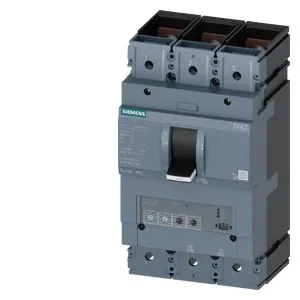
The 3VA2340-7HN32-0HH0: Breaking capacity is the headline here: 330 kA at 240 V, 242 kA at 415/440 V, 187 kA at 500 V, and 7.5 kA at 690 V. It holds full 400 A up to 50 °C, then drops to 385 A at 55 °C, 370 A at 60 °C, 355 A at 65 °C, and 340 A at 70 °C.
What's in the can — auxiliary hardware
The basic switch core is order code 3VA2340-7HN32-0AA0 — that's the bare breaker without the auxiliary hardware. This -0HH0 suffix adds the shunt trip and the switch package. If you're stocking spares, the -0AA0 core plus a separate shunt trip kit is another SKU path, but this pre-assembled variant saves panel-builder wiring time.
Dimensions: 110 mm deep, 138 mm wide, 248 mm tall. That's a standard SENTRON 3VA2 frame footprint — it occupies the same cutout and mounting hole pattern as other 3VA2 3-pole breakers in the 400 A class. If you're swapping out an older 3VF or 3VL breaker, check the mounting centers; the 3VA series uses a different baseplate pattern in some frame sizes. Maximum power loss is 96 W at rated current. That's heat that stays inside the enclosure. In a sealed panel with multiple breakers, factor that into the thermal budget — 96 W per pole is negligible per pole, but four of these in a row adds up to nearly 400 W of internal heat.
Where it lives — environment and compliance
The storage minimum of -40 °C means it can sit in a northern shipping container through winter without damage. The part carries a trip indicator and a voltage trigger — the trip indicator gives a visible flag on the breaker face after a fault, and the voltage trigger allows remote status monitoring through the auxiliary contacts. No communication function onboard, so no Modbus or PROFIBUS integration without an external module.