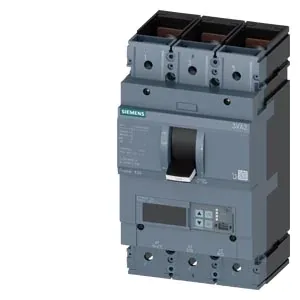
The adjustable trip class (10A, 10/10E, 20/20E, 30/30E) lets you match the thermal curve to the motor's starting profile, so nuisance tripping on inrush is avoided while still protecting the winding.
Motor protection design and ground-fault monitoring
This MCCB is explicitly designed for motor protection, meaning its trip characteristics are optimized for the high inrush and thermal behavior of induction motors. That ground-fault scheme measures the vector sum of the phase currents — if it's non-zero, leakage is present. It's a common approach in European-style motor feeders where residual current devices aren't always installed per phase.
Communication and additional functions
The breaker has communication capability and other measurement functions, which means it can report status, current draw, and trip events to a PLC or BMS over a fieldbus — typical for a SENTRON 3VA with a communication module. This turns a passive protective device into a data point for predictive maintenance and load monitoring.
Depth of 110 mm means it clears most standard gland plates without a spacer.