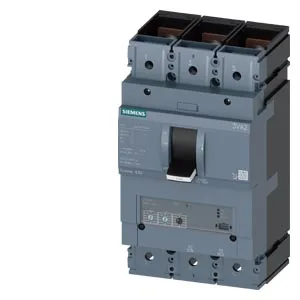
The Siemens SENTRON 3VA2440-5HL32-0JA0 is a 3-pole molded case circuit breaker (MCCB) rated for line protection, carrying a continuous current of 400 A across the full ambient temperature range from 40 °C through 70 °C — no derating needed up to that ceiling. That flat thermal curve is unusual; most MCCBs start stepping down above 40 °C, so this part simplifies panel thermal budgeting if your enclosure runs warm. Interrupting capacity is what defines the fault-handling envelope here: 187 kA at 240 V, 121 kA at 415 V and 440 V, 75.6 kA at 500 V, and 9 kA at 690 V. That is a genuine panel-space and coordination win.
Dimensions are 248 mm high, 138 mm wide, 110 mm deep — a standard 3-pole MCCB footprint for the 400 A frame class. The shunt trip (STL) auxiliary release is built in, so remote tripping from an E-stop or PLC digital output is wired at the factory; no field-add kit needed. The basic switch assembly is order code 3VA2440-5HL32-0AA0, which is the interchangeable switching mechanism inside the molded case.
The 400 A rating is continuous — this breaker will carry 400 A indefinitely at ambient up to 70 °C without tripping, which is the full rated current. The adjustable thermal-magnetic or electronic trip unit (not separately specified here, but the line protection designation implies a standard trip curve) lets you set the long-time pickup and short-time delay to coordinate with downstream feeders. The 600 A minimum and 4 800 A maximum on the spec line refer to the adjustable short-circuit release thresholds — you can set the magnetic trip anywhere in that band to avoid nuisance trips on motor inrush while still clearing a hard fault.