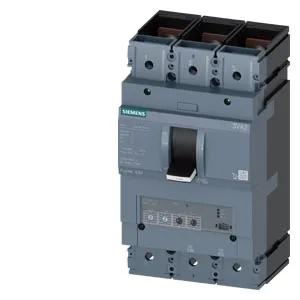
What this 400 A MCCB actually delivers
The 4800 A frame size means the internal mechanism and contacts are built for that interrupting duty, not just the 400 A trip setting. Breaking capacity scales with system voltage: 187 kA at 240 V, 121 kA at 415/440 V, 75.6 kA at 500 V, and 9 kA at 690 V. At 415 V — common for industrial distribution in 400 V class systems — the 121 kA rating gives substantial headroom above typical available fault current, which simplifies selective coordination studies downstream. No auxiliary switch or ground-fault monitoring module is fitted on this variant.
Sourcing and lifecycle — current production, quoted to order
Power loss is 66 W maximum at rated load — a figure to factor into panel thermal calculations, especially in a densely populated enclosure where multiple breakers contribute to internal temperature rise.
The 138 mm width for a 3-pole 400 A MCCB is standard for the SENTRON 3VA2 frame — it occupies a predictable footprint on a DIN-rail or bolted busbar assembly. Verify the existing panel's busbar spacing and mounting holes against these dimensions before committing the cutout. The 70 °C operating ceiling matches the non-derated current rating, so the breaker can sit next to other heat sources in a sealed enclosure without forced derating — a practical advantage for panel builders.
The 3VA1110-5EF32-0LA0 is a smaller-frame breaker (160 A max, 25 kA at 415 V) for branch or light feeder duty. The 3VA2440-5HN32-0CA0 is a full-size main breaker — 400 A continuous, 121 kA at 415 V, with the 4800 A frame. They are not footprint-compatible: the 3VA1110 is narrower and shallower. If a panel was laid out for the 3VA1110 frame, the 3VA2440 will not drop in without busbar and enclosure changes.