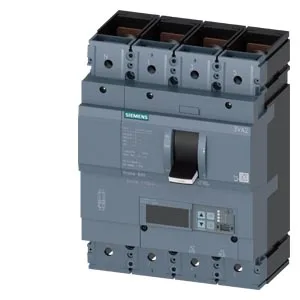
Its 4-pole configuration handles three-phase plus neutral, common in North American and IEC installations where a switched neutral is required.
This breaker's interrupting rating drops as voltage rises: 187 kA at 240 V, 121 kA at 415 V and 440 V, 75.6 kA at 500 V, and 9 kA at 690 V.
Thermal performance and continuous rating
Maximum power loss is 63.5 W, so ventilation planning should account for that dissipation at full load. The adjustable thermal-magnetic trip unit has a full-scale value of 400 A and an initial setting of 80 A, with a short-time withstand of 5 kA limited to 1 second.
Dimensions are 248 mm high, 184 mm wide, 110 mm deep — a standard SENTRON 3VA frame size for 400 A class. Verify the gland plate knockout pattern against your enclosure; the 110 mm depth (4.33 in) leaves clearance behind the door for wiring and accessory modules.
Communication and monitoring features
It also supports ground-fault monitoring via summation current formation on the L + N conductors, which allows detection of leakage without a separate core-balance transformer. No undervoltage release or voltage-triggered trip is fitted as standard.