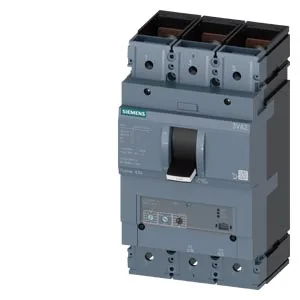
The interrupting capacity sits at 121 kA at 415 V, dropping to 75.6 kA at 500 V and 9 kA at 690 V, so it handles high-fault industrial distribution without cascading upstream.
The 400 A rating is flat across the full 40–70 °C ambient window, which is unusual — most MCCBs start derating above 40 °C. That means this breaker holds its full capacity in a hot panel or near a motor starter without oversizing. The interrupting curve is steep: 187 kA at 240 V, 121 kA at 415 V, 75.6 kA at 500 V, 9 kA at 690 V. At 690 V the 9 kA figure is the limiting case for high-voltage industrial loads. The 138 mm width (5.43 in) is the key panel-space number; it fits a standard 3-pole MCCB cutout in most switchboards. The basic switch core is order code 3VA2440-5MN32-0AA0, so the -0BL0 suffix adds the UVR and auxiliary switch complement.
Mounts in a standard switchboard or motor control center (MCC) bucket. The 110 mm depth leaves clearance for rear-connected bus bars or cable lugs. The UVR coil draws its signal from the line side; verify the control voltage matches the panel's auxiliary supply before energizing. The auxiliary switch block provides dry contacts rated for standard 24 VDC PLC inputs — no external interposing relay needed for status monitoring.