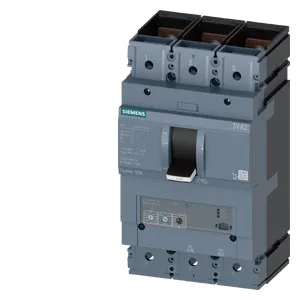
What this MCCB carries and where it fits
The Siemens SENTRON 3VA2440-5MN32-0JH0 is a 3-pole molded case circuit breaker (MCCB) rated for a continuous current Iu of 400 A, with a rated insulation voltage Ui of 800 V. It is the motor protection version, fitted with an ETU350M electronic overcurrent release. The 400 A rating holds across ambient temperatures up to 50 °C; above that it derates to 384 A at 55 °C, 376 A at 60 °C, 368 A at 65 °C, and 360 A at 70 °C — so if your panel runs hot, the continuous current you can actually pull is lower than the nameplate 400 A. Breaking capacity is 187 kA at 240 V AC, 121 kA at 415 V and 440 V, 75.6 kA at 500 V, and 17 kA at 690 V. That 187 kA at 240 V is the figure that matters for high-fault北美 panelboards; the 121 kA at 415 V covers most European industrial distribution. The 17 kA at 690 V is the ceiling — if your system runs 690 V with fault current above that, this breaker is not the right choice. It includes phase failure detection, a trip indicator, and a voltage trigger. The auxiliary contact configuration is 2 auxiliary switches plus 1 trip alarm switch (HQ variant). A shunt trip (STL) is integrated as the auxiliary release. Maximum power loss is 63.5 W — factor that into your enclosure thermal budget.
Panel fit and integration
Dimensions are 248 mm high, 138 mm wide, 110 mm deep. The 138 mm width is the standard 3-pole MCCB footprint for this class — it occupies three 45 mm-wide module positions on a DIN rail or direct-mount plate. The 110 mm depth means it clears most 200 mm-deep enclosures with room for rear-access cabling. Operating temperature range is -25 °C to 70 °C; storage range is -40 °C to 80 °C. The ETU350M release is the electronic trip unit for motor protection — it provides adjustable overload and short-circuit protection curves, plus phase-failure sensitivity. The shunt trip (STL) allows remote tripping from a PLC or emergency-stop circuit. The auxiliary switches and trip alarm switch give status feedback to a control system or HMI.
