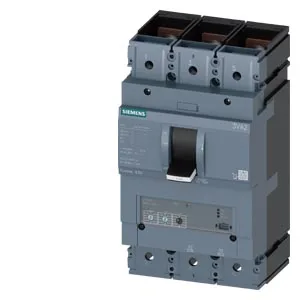
400 A MCCB with ETU320 — what the ratings mean for your panel
The Siemens SENTRON 3VA2440-6HL32-0AG0 is a 3-pole molded case circuit breaker rated for a continuous current Iu of 400 A, fitted with the ETU320 electronic trip unit for line protection. This is the version without undervoltage release, without ground-fault monitoring, and without communication function — a straight line-protection MCCB for distribution panels where selectivity and high fault-current interruption are the priorities. Breaking capacity is the headline here: 242 kA at 240 V, 187 kA at 415 V and 440 V, 121 kA at 500 V, and still 40 kA at 690 V. That 242 kA at 240 V means this breaker can safely interrupt a fault current up to 242,000 A at the lowest common industrial voltage — critical for high-capacity transformer secondaries or large motor control centers where the available fault current is extreme. At 415 V, the 187 kA rating covers most European and Asian distribution networks without needing a current-limiting upstream device. Thermal derating is published across the full operating range: the breaker carries a full 400 A from 40 °C up to 50 °C, then steps down to 384 A at 55 °C, 376 A at 60 °C, 368 A at 65 °C, and 360 A at 70 °C. That means in a hot panel — say, a non-climate-controlled enclosure in a steel mill or Middle East installation — you need to account for the drop starting at 55 °C. The 70 °C maximum operating temperature matches the upper end of most industrial enclosure ratings.
Panel fit and integration
Dimensions are 248 mm high, 138 mm wide, 110 mm deep — a standard SENTRON 3VA2 frame size that fits the usual DIN-rail or screw-mount patterns in distribution boards. The 138 mm width for a 3-pole 400 A frame is consistent with the class; verify busbar spacing and phase-to-phase clearance if retrofitting into an existing panel that was dimensioned for a different manufacturer's 400 A MCCB. Maximum power loss is 63.5 W — that's the heat the breaker dissipates at full rated current. For a multi-breaker lineup in a sealed enclosure, that figure drives the ventilation or cooling calculation. The auxiliary contact configuration is 1 auxiliary switch plus 1 trip alarm switch (HP type), which gives you one NO/NC for status indication and a separate set for trip signaling — enough for a remote alarm or PLC input without sharing contacts. Mechanical endurance rated at 15,000 operations.
