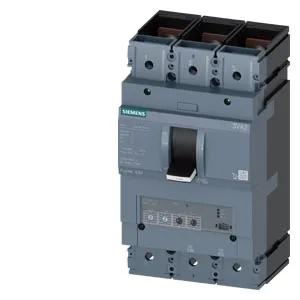
The interrupting ratings are the headline: 242 kA at 240 V AC, 187 kA at 415 V and 440 V, 121 kA at 500 V, and 9 kA at 690 V. At 690 V the 9 kA rating is lower — this is a line-protection breaker, not a motor-starting device, so the 690 V figure matters only if you are feeding a 690 V bus with high fault capacity.
The 4800 A frame is the mechanical platform; the 400 A continuous rating is the thermal-magnetic or electronic trip unit setting. That means this breaker can be ordered with lower amp ratings in the same frame, but the 3VA2440-6HN32-0AF0 ships set for 400 A. The 1-second limited rating of 5 kA is the short-time withstand — important for selective coordination downstream. If you are coordinating with a 100 A feeder breaker, this 400 A main will hold in for a fault on the branch long enough for the downstream device to clear, provided the fault current stays under 5 kA for the first cycle. The trip indicator gives a local mechanical flag so the panel walker sees which pole tripped without opening the door.
That depth is the body only — add projection for the rotary handle or extended terminals. The 138 mm width is standard for a 3-pole SENTRON 3VA2 frame; it fits the same mounting footprint as other 3VA2 3-pole breakers. The breaker is designed for screw-mounting to a backplate or mounting plate in a distribution panel — not DIN-rail snap-on.