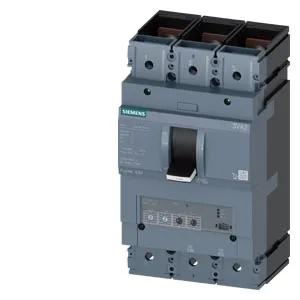
The Siemens SENTRON 3VA2440-6HN32-0CH0 is a 3-pole molded case circuit breaker (MCCB) rated for 400 A continuous current across the full ambient range from 40 °C to 70 °C — no derating curve to chase, per the datasheet. That 400 A holds at every 5 °C step through 70 °C, so it's sized for a warm enclosure without headroom games. Breaking capacity is 242 kA at 240 V, 187 kA at 415 V and 440 V, 121 kA at 500 V, and 9 kA at 690 V. No ground-fault monitoring module is fitted — that's a separate add-on if your spec requires it.
Mounts in a standard MCCB panel footprint. The 3-pole design with 138 mm width fits common busbar systems for this frame class. The undervoltage release (UVR) is factory-fitted — verify coil voltage rating against your control circuit before wiring. The auxiliary switch complement (2 aux + 1 trip alarm HQ) provides status feedback for PLC or annunciator inputs. Maximum power loss is 66 W at rated current — account for that in enclosure thermal calculations, especially in a sealed or high-ambient panel. The 5 kA limited to 1 s rating is a short-time withstand figure for selective coordination studies.