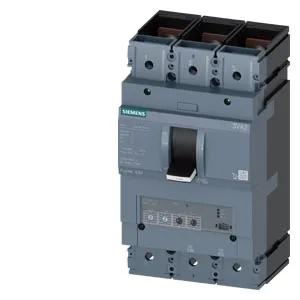
Three-pole construction, so it switches all three phases simultaneously. The interrupting ratings climb steeply at lower voltages: 242 kA at 240 V AC, 187 kA at 415 V and 440 V, 121 kA at 500 V, and 9 kA at 690 V.
Built-in accessories and what they mean on the bench
The auxiliary switches let a PLC or building management system see the breaker position; the trip alarm gives a dedicated signal when the breaker has opened on a fault, not just manually. That distinction matters during fault-finding — you know immediately whether the open was commanded or protective. The base switch inside is order code 3VA2440-6HN32-0AA0, so if you ever need to replace just the switching mechanism, that's the spare part to order. No undervoltage release on this build, and no ground-fault monitoring module fitted.
That 110 mm depth is the dimension you need to check against gland-plate clearance or a shallow backbox — it's not a slimline breaker. The storage range is wider because the breaker isn't dissipating heat when it's sitting on a shelf.