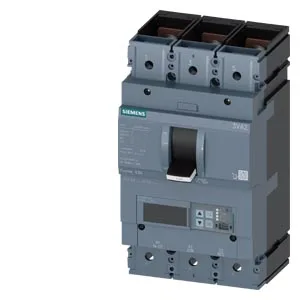
That 400 A holds steady at every temperature step in between, so you can size it for the line current without worrying about summer temperatures in a non-conditioned enclosure. Breaking capacity is 242 kA at 240 V, 187 kA at 415 V and 440 V, 121 kA at 500 V, and 9 kA at 690 V. Those numbers cover most industrial low-voltage distribution systems — the 242 kA at 240 V handles high-fault scenarios common on the secondary side of large transformers, while the 187 kA at 415 V gives solid headroom for 400 V class plant networks. It carries the ETU550 electronic trip unit, which means adjustable long-time, short-time, instantaneous, and ground-fault protection (N-conductor protection adjustable OFF; 20% to 160%).
This is a 3-pole MCCB that bolts into a panel cutout. Max power loss is 63.5 W, which means you should account for that heat in your enclosure thermal calculation. If you're packing several breakers side by side, that waste heat adds up and can drive the internal temperature above the 70 °C operating max if the cabinet isn't vented or cooled.
What the ETU550 trip unit means for coordination
That means it can talk to a higher-level system for power monitoring and remote trip indication — useful for a plant that wants to know which breaker opened without sending someone to the panel. It does not include an undervoltage release or voltage trigger as standard; those are separate accessories.