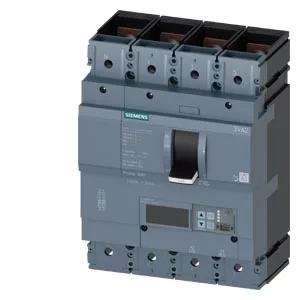
That 400 A holds across ambient temperatures up to 50 °C; above that it derates to 388 A at 55 °C, 380 A at 60 °C, 368 A at 65 °C, and 352 A at 70 °C — so if your panel runs hot near the top of the enclosure, you need to account for that drop when sizing the breaker for the load. Breaking capacity is voltage-dependent: 242 kA at 240 V, 187 kA at 415 V, 85 kA at 440 V, 55 kA at 500 V, and 9 kA at 690 V. The N-conductor protection is adjustable from OFF through 20 % to 130 %, giving flexibility for systems where the neutral needs different protection than the phases.
The ETU550 trip unit supports communication functions, which means it can integrate into a monitoring or selective-coordination scheme via the SENTRON communication platform — useful for a panel that needs remote trip indication or power-quality data without a separate metering module.
Dimensions are 248 mm high, 184 mm wide, and 110 mm deep. Maximum power loss is 63.3 W — not negligible in a densely packed panel. If you're stacking multiple breakers side-by-side, factor that heat into the enclosure's thermal rise calculation, especially above 50 °C ambient where the breaker itself starts to derate. For applications requiring frequent on-load switching (like motor feeders cycled multiple times per shift), consider a contactor upstream instead.