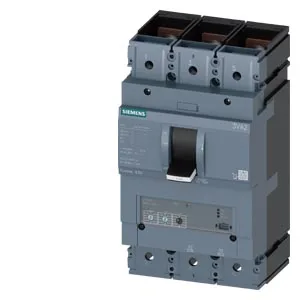
What this 400 A MCCB delivers in a panel
This is a line-protection variant (no voltage trigger, no phase-failure detection), so it's intended for main feeder or large branch protection where the trip curve handles overloads and short-circuits, not motor protection with phase-loss sensitivity.
The interrupting rating drops as system voltage rises: 330 kA at 240 V, 242 kA at 415/440 V, 187 kA at 500 V, and 52.5 kA at 690 V. For a 480 V panel fed from a 500 kVA transformer, the available fault current typically lands between 30–65 kA — this breaker clears that with headroom. At 690 V (common in mining or marine distribution), the 52.5 kA rating still covers most installations, but confirm the calculated SCCR before specifying.
The 400 A rating holds at ambient up to 50 °C. Above that, it derates: 384 A at 55 °C, 376 A at 60 °C, 368 A at 65 °C, 360 A at 70 °C. The maximum power loss is 66 W, which factors into enclosure cooling calculations.
Auxiliary contacts and releases
The UVR ensures the breaker drops out on loss of control voltage — mandatory in safety circuits where a power failure must disconnect loads. The base switch is order code 3VA2440-7HL32-0AA0; the auxiliary trip module is 3VA9608-0BB25.
The breaker carries 15,000 mechanical endurance cycles (latching endurance) — sufficient for infrequent switching applications like main disconnects or backup generator feeders, not for daily motor starting.