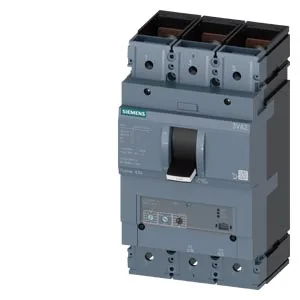
It carries a continuous current rating of 500 A at 40 °C, with a thermal derating curve that holds at 500 A all the way to 50 °C before stepping down: 495 A at 55 °C, 490 A at 60 °C, 485 A at 65 °C, and 480 A at 70 °C. Breaking capacity is rated across the voltage range: 187 kA at 240 V, 121 kA at 415 V and 440 V, 75.6 kA at 500 V, and 9 kA at 690 V.
Auxiliary and release configuration
The UVR means the breaker drops out when control voltage falls below a threshold — standard for safety circuits where a loss of control power must open the motor circuit. The HQ trip alarm switch provides a separate signal path for remote fault indication, which is useful for PLC-based monitoring without tying up the auxiliary contacts.
Panel fit
The 3-pole format with the UVR and auxiliary switch block adds about 18 mm to the width compared to a bare breaker; account for that in your gland-plate layout and wire-bend radius.