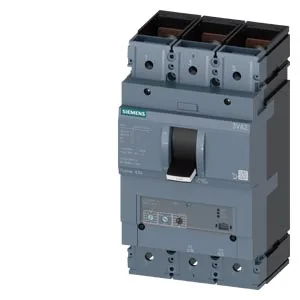
What this MCCB carries and where it sits
The 3VA2450-5MN32-0CC0: Breaking capacity runs 187 kA at 240 VAC, 121 kA at 415 V and 440 V, 75.6 kA at 500 V, and 17 kA at 690 V — so the 240 V figure tells you this breaker handles the high available fault current typical of step-down transformer secondaries, while the 690 V rating confirms it clears faults on 690 V line-fed drives without cascading upstream. Current derating is flat at 500 A from 40 °C through 50 °C, then drops to 495 A at 55 °C, 490 A at 60 °C, 485 A at 65 °C, and 480 A at 70 °C. That means in a hot panel — say 55 °C ambient — you lose only 5 A; the breaker still carries a 495 A load without nuisance tripping.
Trip unit and protection features
The ETU350M electronic trip unit provides adjustable long-time, short-time, instantaneous, and ground-fault protection curves. Phase failure detection is built in — the breaker trips on loss of a phase, which matters for motor loads that would single-phase and overheat. An undervoltage release (UVR) is integrated as standard (design code 0CC0), so the breaker opens automatically when supply voltage drops below the release threshold. That is a common requirement for safety circuits and emergency-stop chains in machinery panels. Two HQ auxiliary switches (form C) are included for remote status indication — open/closed/tripped signals back to a PLC or SCADA. Maximum power dissipation is 101.5 W, so factor that into enclosure thermal calculations.
Mechanical fit and environmental limits
Dimensions: 248 mm high, 138 mm wide, 110 mm deep. That 138 mm width is the standard 3-pole MCCB footprint for this class — it fits existing SENTRON 3VA2 busbar and mounting arrangements without panel rework. Operating temperature range is -25 °C to +70 °C; storage range is -40 °C to +80 °C. The 15 000 mechanical endurance cycles (latching) suit frequent-switching applications like compressor or pump motor feeders.
