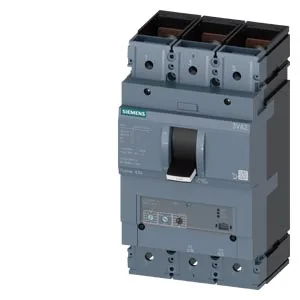
Rated 500 A continuously at 40 °C ambient, it derates predictably: still 500 A at 50 °C, then 495 A at 55 °C, 490 A at 60 °C, 485 A at 65 °C, and 480 A at 70 °C. That derating curve is what you use for panel internal temperature rise calculations — the breaker doesn't lose much headroom until you push past 55 °C. Breaking capacity is 187 kA at 240 V, 121 kA at 415 V and 440 V, 75.6 kA at 500 V, and 9 kA at 690 V.
Trip characteristics and auxiliary fit
The short-time delay band is adjustable between 4 s minimum and 13 s maximum — that's the intentional delay for selectivity with downstream breakers. For motor starting, you'd set it long enough to ride through the start current without cascading upstream. That means you have remote tripping capability and two separate signal contacts plus a dedicated alarm contact for the trip event — enough for a standard motor control center (MCC) bucket without adding external relays. Power loss at full rated current is 99 W maximum — a figure to include in your panel thermal budget, especially if multiple breakers are ganged in a small enclosure.