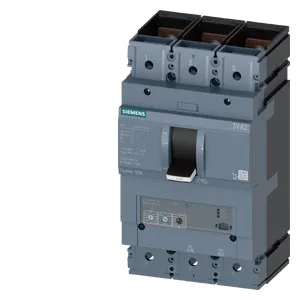
The 800 V rated insulation voltage (Ui) tells you it's comfortable in 480 V and 600 V class panels, and the breaking capacity runs from 187 kA at 240 V down to 17 kA at 690 V. That's enough SCCR headroom for most industrial distribution and motor control center applications.
Breaking capacity — what those numbers mean for your fault study
The interrupting ratings are given at five voltage points, which is exactly what you need for a coordination study. At 240 V it's 187 kA; at 415 V and 440 V it holds at 121 kA; at 500 V it's 75.6 kA; and at 690 V it's 17 kA. That steep drop at 690 V is typical for a 500 A frame — the arc energy scales with voltage, so the breaker can only interrupt so much. If your system fault current at 480 V is, say, 65 kA, this breaker has comfortable margin. The 500 A continuous rating holds steady from 40 °C up to 50 °C, then derates gradually to 480 A at 70 °C.
Auxiliary contacts and trip accessories — what's inside
That means you get both a remote-trip capability and separate signaling for trip vs. normal open/closed status. The integrated auxiliary trip module is order code 3VA9688-0BL30. Phase failure detection is included, which is important for motor loads.
The 110 mm depth includes the case body; you'll need clearance for the shunt trip wiring and auxiliary contact terminals on the front. Mounting is via the standard rear-panel screw pattern or DIN rail adapter (not included).