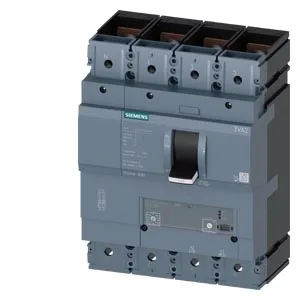
Siemens 3VA2450-6HK42-0AA0 — 500 A SENTRON MCCB with ETU340 Trip Unit
This is a line-protection breaker, not a motor-protection device — the ETU340 provides LSIG (long-time, short-time, instantaneous, ground-fault) curves suited for feeder and main breaker duty in distribution panels. The interrupting capacity is 242 kA at 240 V, 187 kA at 415 V and 440 V, 121 kA at 500 V, and 13 kA at 690 V. The electronic trip unit ETU340 supports adjustable N-conductor protection settings (OFF, 50%, 100%), which is relevant for 4-pole breakers in TN or TT systems where the neutral may need reduced or full protection. The breaker carries a maximum power loss of 99 W at rated current — a figure to factor into enclosure thermal calculations.
Physical Integration and Environment
The enclosure dimensions are 248 mm height, 184 mm width, and 110 mm depth. This is a standard SENTRON 3VA2 form factor — it mounts on a mounting plate or DIN rail via the appropriate adapter, and the 4-pole width occupies roughly 184 mm of panel width. The continuous current rating holds at 500 A up to 50 °C ambient; above that it derates to 495 A at 55 °C, 490 A at 60 °C, 485 A at 65 °C, and 480 A at 70 °C.
The ETU340 trip unit supports adjustable short-time delay and I²t on/off, which enables zone-selective interlocking (ZSI) when paired with downstream breakers. This is the key feature for achieving full selectivity in a distribution hierarchy — without it, the instantaneous trip region would overlap with downstream devices. The 15,000-cycle mechanical endurance is typical for a fixed-mounted MCCB of this class. No communication function is built into this variant — it is a standalone breaker without integrated Modbus, PROFIBUS, or Ethernet. If remote monitoring or trip-event logging is required, a separate communication module or power-quality meter must be added upstream.