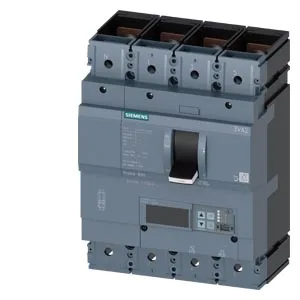
What this 500 A breaker is built for
This is a line-protection version, meaning it's set up for feeder and main breaker duty — protecting cables and busbars from overloads and short circuits in distribution panels, not for direct motor starting.
This breaker's interrupting rating varies significantly with system voltage. At 240 V it's rated 330 kA, at 415 V and 440 V it's 242 kA, at 500 V it drops to 187 kA, and at 690 V it's 9 kA. The ETU860 electronic trip unit supports adjustable I²t curves and zone-selective interlocking, which helps keep nuisance trips off the main breaker during downstream faults.
Thermal derating and real-world panel conditions
The 500 A rating holds steady up to 50 °C ambient. Above that, it derates linearly: 477 A at 55 °C, 455 A at 60 °C, 432 A at 65 °C, and 410 A at 70 °C. The front face is rated IP40, so it's fine for general indoor panel use but not for washdown areas.
Mounting and integration into a panel
This breaker bolts into a panel on a mounting plate — it's not a DIN-rail snap-on unit. Dimensions are 248 mm high, 184 mm wide, and 110 mm deep. That 110 mm depth means it'll fit in most standard deep enclosures, but check the gland plate clearance if you're retrofitting into a shallow box. The N-conductor protection is adjustable between OFF and 20% to 100% of the phase current, which is useful for sizing the neutral on systems with harmonic loads. The ground-fault monitoring uses summation current formation on L + N conductors.