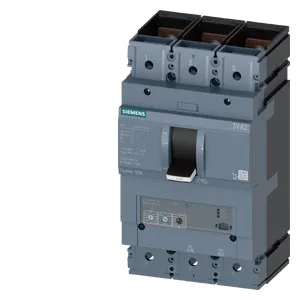
The Siemens 3VA2450-7MN32-0AG0 is a SENTRON molded case circuit breaker (MCCB) designed specifically for motor protection, with a continuous current rating of 500 A at 40 °C that holds flat through 50 °C before a gentle derate curve begins — 495 A at 55 °C, 490 A at 60 °C, 485 A at 65 °C, 480 A at 70 °C. The interrupting ratings tell the real story: 330 kA at 240 V, 242 kA at 415 V and at 440 V, 187 kA at 500 V, and 15.3 kA at 690 V. The basic switch variant is 3VA2450-7MN32-0AA0. No undervoltage release, no communication module — this is a standalone thermal-magnetic MCCB for motor branch circuits.
Sizing and integration
Physical footprint: 138 mm wide, 248 mm tall, 110 mm deep. Maximum power loss is 99 W — that's the heat you need to vent from the enclosure. In a sealed NEMA 4X or IP65 box with multiple breakers, that heat adds up; factor it into the thermal budget. The short-time withstand is 6 kA limited to 1 second — relevant for selective coordination studies.