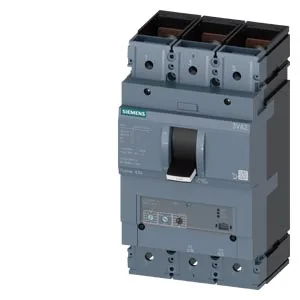
The Siemens 3VA2450-7MN32-0CH0 is a SENTRON molded case circuit breaker (MCCB) built for motor protection, rated 500 A at 40 °C and carrying a breaking capacity of 330 kA at 240 V. It is a three-pole unit with an undervoltage release, phase failure detection, and a trip indicator — the kind of protection package you want on a pump or compressor motor where a single-phase condition could cook the winding before the overload relay trips.
At 240 V it interrupts 330 kA, dropping to 242 kA at 415 V and 440 V, then 187 kA at 500 V, and 15.3 kA at 690 V.
At 55 °C it drops to 495 A, then 490 A at 60 °C, 485 A at 65 °C, and 480 A at 70 °C.
The breaker measures 248 mm tall, 138 mm wide, and 110 mm deep. That depth is the critical dimension for shallow backpanel enclosures — 110 mm is about 4.33 inches, so it fits in standard 6-inch-deep cabinets with room for wiring behind it. Width of 138 mm (5.43 in) is typical for a 500 A frame; check the gland plate knockout spacing if retrofitting into an existing panel.
The UVR will drop the breaker if control power is lost — useful for emergency-stop circuits where you want the breaker to open on a safety signal, but be aware it means the breaker cannot be reclosed until control voltage is restored. The trip alarm switch gives a separate signal when the breaker trips on fault, which can feed a PLC input for remote fault annunciation.
Time-current characteristics
The short-time withstand rating is 6 kA limited to 1 second. The minimum tripping time is 4 s and maximum is 13 s — these are likely the thermal-magnetic or electronic trip curve bands. For motor starting applications, the 4 s minimum gives enough time for a standard induction motor start under load without nuisance tripping.