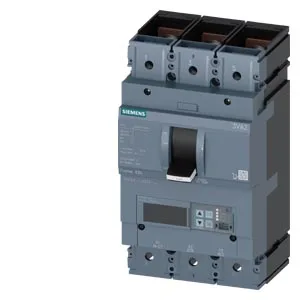
The real-world number to watch is the derating curve: at 50 °C it handles 570 A, at 60 °C it drops to 510 A, and at 70 °C it is down to 450 A. Breaking capacity climbs with voltage: 121 kA at 240 V, 75.6 kA at both 415 V and 440 V, 52.5 kA at 500 V, and 9 kA at 690 V. That means in a 480 V distribution panel (common in North America) the breaker can interrupt faults up to 52.5 kA without upstream fuses — enough for most industrial service-entrance duty. At 690 V the 9 kA figure still covers downstream feeder faults but not main incoming. Ground-fault monitoring is built in as summation-current formation on the L-conductor — it detects leakage by summing the phase currents, so no external GF relay is needed for that function.
At 248 mm tall, 138 mm wide, and 110 mm deep, this MCCB fits standard 3-pole MCCB mounting footprints in switchboards and panelboards. The 110 mm depth (4.33 in) is shallow enough that it clears most gland plates and back-panel wiring gutters without forcing a deeper enclosure. Width of 138 mm (5.43 in) matches the typical 3-pole SENTRON 3VA frame — verify the busbar pitch if retrofitting into an older panel.
Electrical and environmental limits
The breaker includes a communication function but no undervoltage release or voltage trip built in. The trip indicator is not present on this variant.