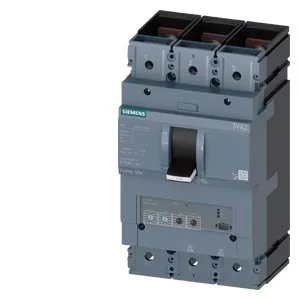
The 3-pole design handles three-phase feeders up to 690 VAC. Breaking capacity is the headline here: 187 kA at 240 VAC, 121 kA at 415/440 VAC, 75.6 kA at 500 VAC, and 9 kA at 690 VAC.
The adjustable thermal-magnetic trip is set with a full-scale of 630 A and a minimum trip of 945 A, maximum 5 670 A — that's a 1.5x to 9x range on the magnetic pickup. For motor feeders you'd typically set the magnetic short-circuit threshold above the inrush; for resistive loads you can run it tighter. The trip indicator and voltage trigger (shunt trip, STL) are built in, so you get remote trip capability without adding a separate undervoltage release. Auxiliary switching comes as one auxiliary switch, one trip alarm switch, and one electrical alarm switch (HQ configuration). That's enough for remote status on the breaker position, a fault signal, and a separate alarm for electrical trip — three discrete signals back to the PLC or SCADA without an external interposing relay. Power loss is 162 W maximum at rated load. That's not trivial in a sealed enclosure — factor it into your thermal budget alongside the other breakers in the same panel.
Dimensions are 248 mm high, 138 mm wide, 110 mm deep — it needs about 3.4 liters of volume in the enclosure. Panel builders should check the gland plate clearance for the shunt trip and auxiliary switch wiring; the terminals are accessible from the front. No communication function on this variant — it's a standalone breaker, not a smart metering unit.