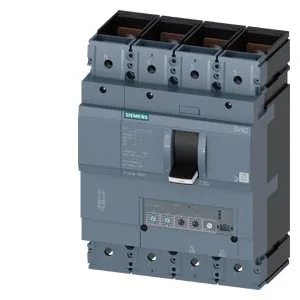
The adjustable thermal-magnetic trip unit covers a range from 945 A to 5670 A — that is the instantaneous short-circuit pickup window, not the continuous rating. Set it low for a feeder with inrush headroom; set it high for a main with full selectivity downstream. Interrupting capacity is the headline here: 187 kA at 240 V, 121 kA at 415/440 V, 75.6 kA at 500 V, and 9 kA at 690 V. That SCCR curve means this breaker handles high-fault utility feeds at low voltage and still clears a 9 kA fault on a 690 V drive bus. For a 480 V panel in North America the relevant number is the 415/440 V row — 121 kA symmetrical — which covers virtually any transformer-fed service. Thermal derating is published stepwise from 40 °C to 70 °C: 630 A at 40 °C, 612 A at 45 °C, 593 A at 50 °C, 575 A at 55 °C, 557 A at 60 °C, 538 A at 65 °C, 520 A at 70 °C.
Dimensions: 248 mm high, 184 mm wide, 110 mm deep. Ground-fault monitoring uses summation current formation on L + N conductors — the neutral passes through the same sensor core. No separate ground-fault module required for that function, but the breaker does not include a voltage trip or undervoltage release (no UVR coil fitted). If the spec calls for shunt trip or UVR, that is a separate accessory add-on.
The lifecycle stage is current — Siemens still produces this order code. No end-of-life notice or last-time-buy date is available. Maximum power loss is 162 W at full rated current. That is the heat the panel ventilation must reject — factor it into the enclosure thermal calculation, especially if the MCCB shares a compartment with electronics or other heat sources.