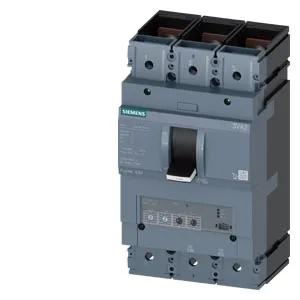
Interrupting capacity and what it means on site
The 3VA2463-5HN32-0AF0: The interrupting rating is the headline: 187 kA at 240 V, 121 kA at 415 V and 440 V, 75.6 kA at 500 V, and 9 kA at 690 V. That 187 kA figure at 240 V means this breaker can safely clear a fault of that magnitude without welding its contacts or rupturing the case — critical for high-fault service entrances or large transformer secondaries where available fault current is high. At 690 V the rating drops to 9 kA, which still covers most industrial motor circuits at that voltage, but if you're feeding a 690 V bus with a big transformer, check the available fault current against that number.
Thermal derating — the number that actually governs your load
The 630 A continuous rating is at 40 °C ambient. In a hot panel — say 50 °C — the breaker carries 593 A; at 60 °C it's 557 A; at 70 °C it's 520 A. That's a 17% drop from the 40 °C base. If you're packing this into a crowded enclosure or it's sitting near other heat sources, use the derated figure for your load calculation, not the catalog number. Power loss at full load is 162 W, which adds to the enclosure's thermal budget.
Physical fit and auxiliary configuration
Dimensions: 138 mm wide, 248 mm tall, 110 mm deep. That width is standard for a 3-pole frame at this rating — it'll bolt into a panel cutout sized for a 630 A SENTRON MCCB. The auxiliary switch configuration is 1 auxiliary switch plus 1 trip alarm switch (HQ design), which gives you one N/O-N/C for status indication and one dedicated to signaling a trip event. No undervoltage release, no ground-fault monitoring, no communication function — this is a plain-vanilla line-protection breaker. If you need those options, you're looking at a different suffix.
