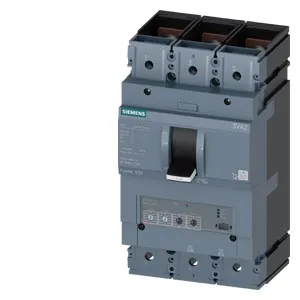
That 630 A figure is the thermal base — the breaker holds that current indefinitely without tripping at a 40 °C ambient. For higher ambient temperatures inside a crowded enclosure, the rated current derates stepwise: 612 A at 45 °C, 593 A at 50 °C, 575 A at 55 °C, 557 A at 60 °C, 538 A at 65 °C, and 520 A at 70 °C. The breaker is 3-pole, rated insulation voltage 800 V, and carries a maximum power loss of 164.5 W. That power loss matters for enclosure thermal calculations: at full load the breaker dissipates heat equivalent to a small resistive heater, so verify your cabinet's ventilation or derating factor.
Breaking capacity across system voltages
This MCCB's interrupting capacity varies sharply with system voltage — a key selection parameter for fault-current studies. At 240 V it interrupts 187 kA; at 415 V and 440 V, 121 kA; at 500 V, 75.6 kA; and at 690 V, 9 kA.
Auxiliary and undervoltage release configuration
That gives you remote status — open/closed, tripped on fault, and a separate electrical alarm contact for annunciation. The UVR design is specified as an undervoltage release. No communication function is included on this variant.
Mounting dimensions and panel fit
Physical footprint: width 138 mm, height 248 mm, depth 110 mm. The 3VA2 frame is designed for screw-mounting on a backplate or mounting plate inside a distribution panel or MCC bucket. The 110 mm depth includes the case body but not the handle throw — allow clearance for the toggle arc and any auxiliary wiring. The 138 mm width means it occupies roughly 5.4 inches of horizontal space per pole; plan your busbar and lug landing zones accordingly.