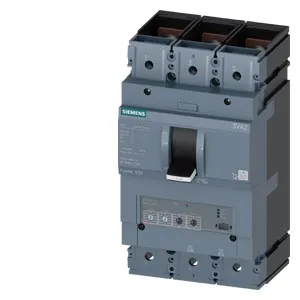
It carries 630 A continuous at 40 °C across three poles, with a maximum interrupting capacity of 187 kA at 240 V — that figure drops to 121 kA at 415 V and 440 V, 75.6 kA at 500 V, and 9 kA at 690 V, so the voltage class of your fault bus decides whether this breaker clears a high-energy arc without venting or welding contacts. The 630 A rating is at 40 °C ambient; above that you derate linearly — 612 A at 45 °C, 593 A at 50 °C, 575 A at 55 °C, 557 A at 60 °C, 538 A at 65 °C, and 520 A at 70 °C.
The depth of 110 mm means it clears most 200 mm-deep enclosures with room for rear-connected busbars or a shunt trip (STL) wired behind the base. No communication module or ground-fault monitoring on this order code. If you need remote trip indication or GF protection, you step up to the 3VA2 with electronic trip units and communication options.
Maximum power loss is 162 W at full rated current — that heat has to leave the enclosure. If you're retrofitting into a panel originally built for a 5SQ2370-2YA05 frame, check the mounting footprint and busbar centers; the SENTRON 3VA series uses a different bolt pattern than the older 5SQ generation, so a direct drop-in without drilling or a busbar adapter is unlikely.