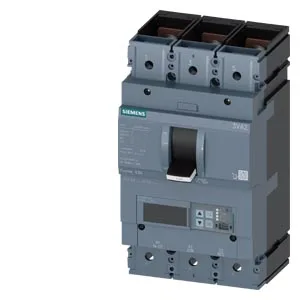
The 3-pole line-protection variant carries an ETU550 electronic trip unit, which gives you adjustable long-time, short-time, instantaneous, and ground-fault curves — not a fixed thermal-magnetic, so coordination studies actually hold across the temperature range. Breaking capacity is the headline number for fault duty: 187 kA at 240 V, 121 kA at 415 V and 440 V, 75.6 kA at 500 V, and 17 kA at 690 V. Thermal derating is published per degree: full 630 A at 40 °C, stepping down to 450 A at 70 °C. That's a spec you can plan the gland plate around without guessing.
Footprint is 138 mm wide, 248 mm tall, 110 mm deep. Comes with two auxiliary switches (HQ type) and an undervoltage release (UVR) integrated. The UVR is the design-of-the-auxiliary-release variant — it drops the breaker on loss of control voltage, which is standard for emergency-stop chains or undervoltage protection schemes. Communication function is built in, so you can wire it to a PLC or BMS for remote trip indication and status without adding a separate module. No phase-failure detection on this variant; if you need that, you'd step to a different ETU option.