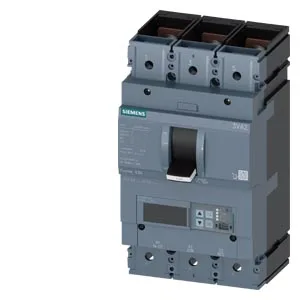
The Siemens SENTRON 3VA2463-5JP32-0DC0 is a 3-pole molded case circuit breaker rated for 630 A continuous current (Iu) at 40 °C, with an ETU550 electronic trip unit that gives you adjustable long-time, short-time, instantaneous, and ground-fault protection curves. That 630 A figure is the thermal base — at 45 °C it derates to 600 A, at 50 °C to 570 A, and so on down to 450 A at 70 °C, so the actual ampacity in your enclosure depends on your internal ambient and how tightly you pack the other breakers. Interrupting capacity is 187 kA at 240 V, 121 kA at 415 V and 440 V, 75.6 kA at 500 V, and 17 kA at 690 V. Communication function is built in — the ETU550 supports Modbus RTU over the optional communication module, letting you pull trip data and waveform captures without a separate gateway.
Integration notes — footprint and panel fit
Maximum power loss is 164.5 W at rated current.
Selectivity and coordination — what the ETU550 enables
That means you can set the short-time delay to ride through downstream feeder breaker faults, achieving full selectivity (discrimination) up to the breaker's short-time withstand rating. For a site electrical engineer building a coordinated distribution system, this is the trip unit that lets you avoid nuisance main-tripping on a branch fault. Mechanical endurance is 15,000 operations latching — that's the handle mechanism life, not the electrical switching life under load.