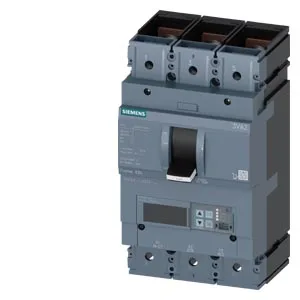
Its interrupting capacity defines where it can sit in a distribution board: 187 kA at 240 V AC, 121 kA at 415 V and 440 V, 75.6 kA at 500 V, and 17 kA at 690 V. The 17 kA at 690 V still covers most industrial motor-control-center buswork.
Thermal derating — the real-world current rating
The 630 A rating holds only at 40 °C ambient inside the enclosure. At 50 °C the breaker is good for 570 A; at 60 °C it drops to 510 A; at 70 °C — the maximum operating ambient — it is 450 A. The 162 W maximum power loss also needs to be vented; a sealed, unventilated enclosure will push the internal temperature above the 70 °C operating ceiling.
Trip unit, auxiliaries, and communication
This MCCB ships with the ETU560 electronic overcurrent release, which supports LSIG (long-time, short-time, instantaneous, ground-fault) protection profiles. The ground-fault monitoring uses summation-current formation on the L-conductor. It comes with one auxiliary switch and one trip-alarm switch (HP type) pre-installed — order code 3VA9608-0BB11 for the integrated auxiliary trip. The breaker also has a communication function, so it can interface with a BMS or SCADA system for remote monitoring and trip-event logging. No undervoltage release or voltage-trigger release is fitted from the factory.
Dimensions are 248 mm high, 138 mm wide, 110 mm deep — a standard 3-pole MCCB footprint for the SENTRON 3VA frame. The front face carries an IP40 protection rating, so it is suitable for installation inside a locked electrical enclosure where no water spray or dust ingress is expected. The breaker accepts lug or bus-bar connections on both line and load sides; no special adapter kit needed for most 630 A bus systems.