What it is and what it does
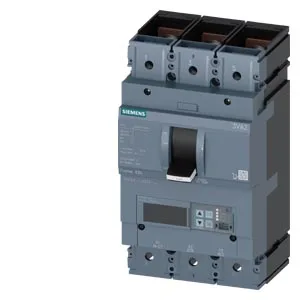
The Siemens SENTRON 3VA2463-5JQ32-0CC0 is a 3-pole molded case circuit breaker (MCCB) rated for line protection — the primary overcurrent and short-circuit safeguard in a distribution panel or motor control center. It carries a continuous current of 630 A at 40 °C, with a thermal derating curve that steps down to 450 A at 70 °C, so the installer sizes the breaker for the actual ambient inside the enclosure, not the nameplate max. Breaking capacity is 187 kA at 240 V, 121 kA at 415 V and 440 V, 75.6 kA at 500 V, and 9 kA at 690 V — the 415 V figure covers the common European low-voltage distribution level, so this breaker handles high-fault-current scenarios on a 400 V bus without cascading upstream. The magnetic trip is adjustable between 945 A and 5 670 A (1.5× to 9× In), which lets the commissioning engineer set the instantaneous pickup to coordinate with downstream branch breakers or motor-starting inrush.
Panel fit and integration
Dimensions are 248 mm high × 138 mm wide × 110 mm deep — a standard SENTRON 3VA2 frame that fits the existing cutout and bus-bar spacing in most 630 A switchboards. The 110 mm depth leaves clearance behind the gland plate for cable bending radius. This variant includes a communication function and an undervoltage release (UVR) as the auxiliary release, plus two HQ auxiliary switches. The UVR trips the breaker when control voltage drops below the dropout threshold — standard for emergency-stop or safety-circuit isolation in a machine panel. Maximum power loss is 164.5 W — relevant for thermal budgeting inside a sealed enclosure; the panel designer accounts for this when sizing ventilation or forced cooling.
Lifecycle and sourcing
The basic switch variant 3VA2463-5JQ32-0AA0 is the same frame without the communication module — a drop-in alternative if the BOM does not require the comms function, though the -0CC0 carries the UVR and auxiliary switches as standard.
