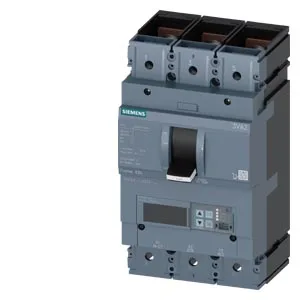
What this MCCB carries and what that means for your panel
The Siemens 3VA2463-5JQ32-0DL0 is a 3-pole SENTRON molded case circuit breaker rated for a continuous current of 630 A at 40 °C, with a maximum breaking capacity of 187 kA at 240 V AC. That interrupting rating means it can safely clear a fault up to 187 kA without welding its contacts or rupturing the case — critical for high-fault-capacity service entrances or large motor control centers where upstream transformers can deliver massive short-circuit current. The ETU560 electronic trip unit gives you adjustable long-time, short-time, instantaneous, and ground-fault protection curves, so you can coordinate selectively with downstream feeders instead of relying on a fixed thermal-magnetic curve. The breaker includes an undervoltage release (UVR) as standard, which drops the trip mechanism if control voltage falls below a set threshold — useful for preventing automatic restart after a brownout on safety-critical loads. It also carries ground-fault monitoring via summation current formation on the L-conductor, meaning it measures the vector sum of phase currents to detect leakage to earth without needing a separate core-balance CT. Auxiliary contact configuration is 2 auxiliary switches plus 1 trip alarm switch plus 1 electrical alarm switch (HQ type), giving you status feedback for PLC inputs, remote annunciation, and trip-cause differentiation without adding external relay logic.
Sizing and thermal derating — the real-world numbers
The 630 A rating is at 40 °C ambient. If your panel runs hotter — and most enclosed switchgear does — you need to derate: 600 A at 45 °C, 570 A at 50 °C, 540 A at 55 °C, 510 A at 60 °C, 480 A at 65 °C, and 450 A at 70 °C. That's a 28% drop from 40 °C to 70 °C, so if this breaker is going into a compact, poorly ventilated enclosure alongside other heat sources, size your load accordingly or add forced cooling. Power loss at full rated current is 164.5 W maximum. That heat has to be dissipated inside the enclosure — factor it into your thermal budget, especially if multiple breakers are ganged in the same section. Dimensions are 248 mm high, 138 mm wide, 110 mm deep. The 138 mm width across three poles is standard for this frame size, but verify your busbar spacing and mounting footprint before cutting gland plates.
Breaking capacity across voltage levels — selectivity planning
This breaker's interrupting capacity varies significantly with system voltage: 187 kA at 240 V, 121 kA at both 415 V and 440 V, 75.6 kA at 500 V, and 17 kA at 690 V. For a 480 V panel (common in North America), you're looking at the 75.6 kA rating at 500 V — that's still substantial headroom for most industrial services, but if your available fault current at the line side exceeds that, you'll need a current-limiting upstream device or a higher-rated frame.
Sourcing and lifecycle posture
The base switch (the core mechanism without accessories) is order code 3VA2463-5JQ32-0AA0, and the integrated auxiliary trip module is 3VA9608-0BB25 — useful to know if you're stocking spares or need to replace just the trip unit without swapping the entire breaker.
