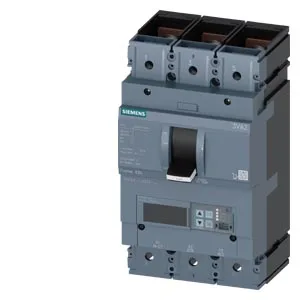
That 630 A figure is the thermal baseline — the breaker carries that current indefinitely in a 40 °C ambient. Above that temperature, the rating steps down: 600 A at 45 °C, 570 A at 50 °C, all the way to 450 A at 70 °C. The breaking capacity tells you what fault it can safely interrupt. At 240 V it clears 187 kA; at 415 V and 440 V it handles 121 kA; at 500 V it drops to 75.6 kA; at 690 V it is still rated at 17 kA. The 17 kA at 690 V means it can also serve 600 V class systems, but with lower fault-current headroom. The ETU560 electronic trip unit handles the overcurrent protection. It is a communication-capable release, so it can talk to a higher-level system for monitoring or remote trip indication — useful if you are feeding data to a BMS or SCADA. No undervoltage release and no phase failure detection are built in, so if those are needed they must be added externally.
That 138 mm width for a 3-pole 630 A frame is standard — it fits the usual panel cutout and bus-bar spacing for this class. The 110 mm depth means it will clear most standard enclosure depths, but check the gland-plate clearance if you are mounting it near the back wall of a shallow cabinet. No auxiliary contacts are included, so if you need status feedback to a PLC, order the auxiliary switch block separately. Maximum power loss is 162 W. That is the heat it dumps into the enclosure at full rated current. In a sealed panel, factor that into your thermal calculation — especially if the MCCB is grouped with other high-current devices.