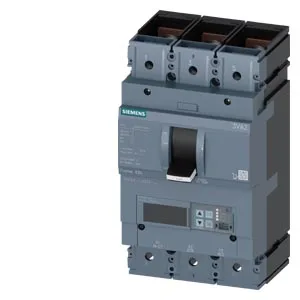
The Siemens 3VA2463-5JQ32-0KH0 is a 3-pole SENTRON molded case circuit breaker rated 630 A continuous at 40 °C, with a maximum breaking capacity of 187 kA at 240 V AC. That 187 kA figure drops to 121 kA at 415/440 V and to 17 kA at 690 V — so the voltage on your line determines whether this breaker handles a high-fault service entrance or a downstream feeder. That matters when you're retrofitting into a panel that doesn't have a dedicated ground-fault sensor. Power loss hits 162 W maximum at rated load. In a densely packed enclosure, that heat has to move — leave breathing room around the breaker or factor in forced ventilation.
Auxiliaries and integration — what's built in, what's not
The breaker is 138 mm wide, 248 mm tall, and 110 mm deep. That 138 mm width is a fixed 3-pole frame — it occupies three adjacent mounting slots on the panel backplate. The depth of 110 mm means it clears most standard enclosure depths, but check your door clearance if you're mounting a rotary handle or motor operator on the front. Communication function is included on this variant, though the evidence doesn't specify the protocol — expect PROFIBUS, PROFINET, or Modbus depending on the communication module ordered separately. The base breaker has the slot and wiring harness ready.
Because this is a current-production part with multiple configurable options (trip unit, auxiliaries, communication), the exact order code you see is the one you need to quote. The base switch is 3VA2463-5JQ32-0AA0; the -0KH0 suffix adds the shunt trip, the 2+1 auxiliary block, and the communication-ready build. No field retrofitting required.
Selectivity and coordination — where this breaker fits
At 630 A frame size, this MCCB is typically a main or large feeder breaker in a 480 V or 600 V distribution panel. The 187 kA interrupting rating at 240 V makes it suitable for service-entrance applications on the low-voltage side of a transformer; the 121 kA at 415 V covers most industrial 400 V-class systems. For frequent switching duty, factor in the electrical endurance curve (not listed here) which will be lower at full load. This breaker is designed for infrequent switching and protection, not as a motor-starting contactor.