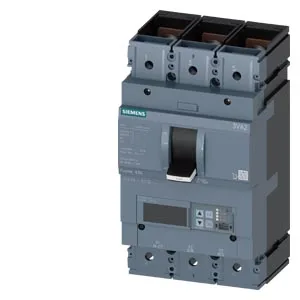
630 A MCCB with communication — line protection for high-fault panels
Its interrupting capacity reaches 187 kA at 240 V and 121 kA at 415/440 V, dropping to 9 kA at 690 V — the 240 V and 415 V figures are what govern for most North American and European line-side installations, so the breaker handles high-fault utility connections without cascading upstream. The line-protection design means the thermal-magnetic trip curve is calibrated for cable and busbar protection rather than motor overload, so pair it with a separate motor-protective device downstream if feeding a motor load. This unit includes a communication function and other measurement functions, so it can report current draw and trip events over a bus — useful for a facility monitoring system or a power-management scheme. The auxiliary switch configuration carries two HQ auxiliary switches plus a shunt trip release (STL), giving remote open/close status and a remote-trip capability without adding an external undervoltage module.
The continuous current rating drops from 630 A at 40 °C to 450 A at 70 °C (–). For a panel that runs warm — say 50 °C ambient inside the enclosure — the usable rating is 570 A, so size the upstream transformer and busbars accordingly. Maximum power loss is 162 W; that heat needs to be factored into the enclosure ventilation, especially if the breaker is enclosed in a non-ventilated cabinet with other heat sources.