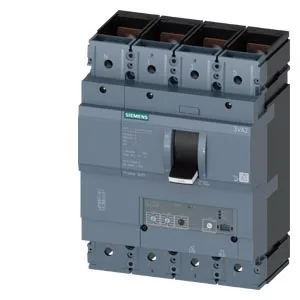
The ETU320 is a basic electronic release with fixed settings (no adjustable long-time, short-time, or ground-fault curves), so selectivity studies need to account for its fixed trip characteristics. At 40 °C it carries the full 630 A; derate linearly through 70 °C where it holds 520 A. The interrupting ratings are substantial: 242 kA at 240 V AC, 187 kA at 415 V and 440 V, 121 kA at 500 V, and 9 kA at 690 V.
Physical Fit & Panel Integration
The breaker measures 248 mm high, 184 mm wide, and 110 mm deep. Power dissipation at full load is 162 W, so panel cooling needs to account for that heat rejection, especially in a sealed enclosure.
Trip Unit & Coordination
The minimum rated short-circuit breaking capacity is 945 A, and the maximum is 5,670 A. For selectivity with downstream breakers, the fixed curve means you coordinate by sizing the downstream breaker's instantaneous trip below the ETU320's magnetic threshold. The insulation voltage rating is 800 V, so it's suitable for 690 V systems but the interrupting capacity at that voltage (9 kA) is the binding constraint. No communication function, no voltage trigger, no undervoltage release, and no ground-fault monitoring are built in — if you need those, you'd move to a 3VA2 with an ETU6xx or ETU8xx trip unit.