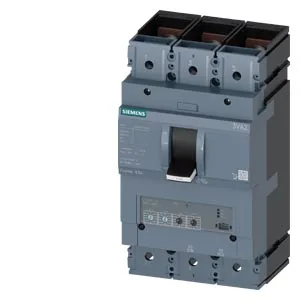
That 630 A is the thermal rating at 40 °C ambient — at 50 °C it's 593 A, at 60 °C it's 557 A, so the derating curve matters if your panel runs hot. The interrupting capacity is the headline: 242 kA at 240 V, 187 kA at both 415 V and 440 V, 121 kA at 500 V, and 9 kA at 690 V. Those numbers define where this breaker can sit in a fault-current study — it handles high available fault current at the lower voltages common in North American distribution, and still carries solid interrupting at 415 V for IEC installations. This is a line-protection design (not motor protection), so it's sized for feeder or main breaker duty. The ground-fault monitoring variant uses summation current formation on the L-conductor — it detects residual current by summing the phase currents, which is typical for solidly-grounded systems where you need GF trip coordination downstream.
The breaker measures 138 mm wide by 248 mm tall by 110 mm deep. That 110 mm depth is the front-to-back dimension behind the panel door — important for gland-plate clearance and whether it fits a shallow enclosure.
Installation environment
Maximum power loss is 162 W — that's the heat it dumps into the enclosure at full rated current, so factor that into your thermal budget if the panel is sealed or has limited ventilation. No undervoltage release, no communication function, no voltage trip — this is a straight thermal-magnetic or electronic-trip breaker without add-on modules.