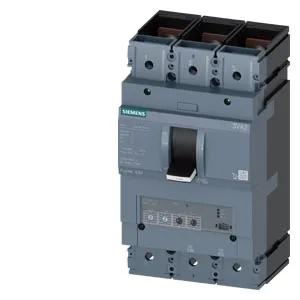
What this 630 A MCCB is and what it does
The Siemens 3VA2463-6HN32-0AA0 is a SENTRON molded case circuit breaker (MCCB) rated for 630 A continuous current at 40 °C, with three poles and an ETU350 electronic trip unit for line protection. It's built for high-fault applications: 242 kA breaking capacity at 240 V and 187 kA at 415 V, dropping to 121 kA at 500 V and 9 kA at 690 V. That 242 kA figure at 240 V means it can safely interrupt a fault current that high without blowing apart — critical for large transformer secondaries or busway feeds where available fault current is serious. The 630 A rating tells you this is sized for a main feeder or a big motor circuit, not a branch panel.
Thermal derating and panel integration
The 630 A rating holds at 40 °C ambient. Push the panel ambient to 50 °C and the breaker derates to 593 A; at 60 °C it's 557 A; at 70 °C it's 520 A. If this breaker lives in a crowded enclosure near other heat sources, you'll need to account for that derating — the 162 W max power loss doesn't disappear, it heats the cabinet. Dimensions are 138 mm wide by 248 mm tall by 110 mm deep, so it fits a standard MCCB footprint but check your gland-plate clearance on the depth. IP40 on the front means it's fine inside a closed panel but not for washdown or outdoor exposure without an enclosure.
What the ETU350 trip unit means for coordination
The ETU350 is an electronic trip unit with adjustable overload and short-circuit protection curves, which gives you selectivity downstream. That matters when this breaker feeds sub-feeders: you can set the time delays so a fault on a branch trips the branch breaker first, not this main. No undervoltage release, no ground-fault monitoring, no communication function on this variant — it's a straightforward line-protection device. If you need those features, you'd look at a different 3VA2 option code.
