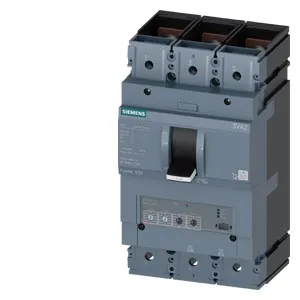
The Siemens 3VA2463-6HN32-0DA0 is a 3-pole SENTRON molded case circuit breaker (MCCB) rated for line protection, with a continuous current of 630 A at 40 °C and a maximum interrupting capacity of 242 kA at 240 V. It's designed to sit in a distribution panel or switchboard protecting feeders and large loads against short circuits and overloads. The interrupting curve drops to 187 kA at 415 V and 440 V, then to 121 kA at 500 V, and 9 kA at 690 V — so the available fault current at the installation point determines which voltage rating governs the selection. The basic switch (the breaker mechanism without accessories) is order code 3VA2463-6HN32-0AA0, which is the core unit this release gets bolted onto.
Current derating across ambient temperature
In a warm panel — say 50 °C — the breaker carries 593 A continuous; at 60 °C it's 557 A; at 70 °C it's 520 A. Power loss at max rated current hits 164.5 W, which adds to the enclosure's thermal load — factor that into the ventilation or cooling budget.
Mounts on a backplate or DIN-rail adapter in a panel; the 110 mm depth leaves room behind a 200 mm deep enclosure door without the breaker body hitting the gland plate.