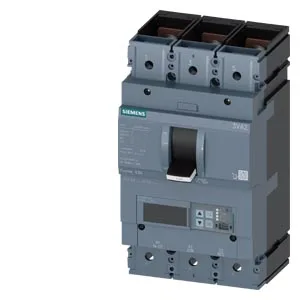
What this 630 A MCCB delivers — and what it asks of the panel
The Siemens SENTRON 3VA2463-6JP32-0AH0 is a 3-pole molded case circuit breaker rated for 630 A continuous current, with a breaking capacity that ranges from 242 kA at 240 V down to 9 kA at 690 V — so the SCCR you can claim downstream depends entirely on the line voltage feeding this breaker. At 40 °C ambient it carries 630 A; derate to 450 A by 70 °C. The trip indicator and the built-in communication function mean this breaker reports its state to the control system without a separate aux contact block — saves a DIN rail slot and a wiring pair per unit.
Breaking capacity — where the coordination engineer looks first
The 242 kA at 240 V is the headline figure, but the real selectivity design point is 187 kA at 415 V and 440 V — common industrial distribution voltages where this breaker still clears a 187 kA fault without upstream devices needing to trip. At 690 V the breaking capacity drops to 9 kA — that is a hard limit for 690 V systems; the breaker is not intended for high-fault 690 V main feeders. The minimum trip setting is 945 A, maximum 5 670 A — a 6:1 adjustment range that covers motor-start inrush and transformer magnetizing without nuisance trips.
Base switch variant is 3VA2463-6JP32-0AA0; the -0AH0 adds the communication module and HQ trip alarm.
Panel integration — what the dimensions and auxiliaries mean for the layout
Width 138 mm matches the standard SENTRON 3VA2 three-pole frame. Depth 110 mm (4.33 in), height 248 mm (9.76 in). Maximum power loss of 162 W means the enclosure needs ventilation or a fan above ~40 °C ambient — that 162 W is dissipated inside the cabinet, not in the busbars.