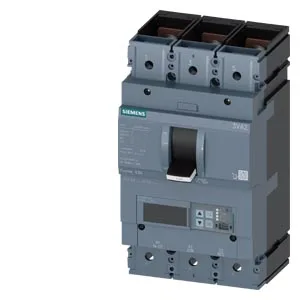
Its interrupting capacity reaches 242 kA at 240 V AC and 187 kA at 415/440 V AC, dropping to 121 kA at 500 V and 9 kA at 690 V — a curve that tells you this breaker is built for low-voltage main feeders where fault currents run high, not for 690 V branch circuits. The adjustable thermal-magnetic trip unit covers a range from 945 A minimum to 5 670 A maximum, giving the specifying engineer selectivity headroom downstream. Communication function is built in, which means this breaker can report status and trip events to a higher-level control system — useful for a plant-wide power monitoring scheme where you want to know which feeder cleared before the maintenance crew walks the line.
Thermal derating and power dissipation
Above that, the breaker derates linearly: 600 A at 45 °C, 570 A at 50 °C, 540 A at 55 °C, 510 A at 60 °C, 480 A at 65 °C, and 450 A at 70 °C. If your panel internal ambient runs 50 °C — common in a packed switchboard — you lose 60 A of headroom. Maximum power loss is 164.5 W, so ventilation or forced cooling may be needed in a sealed enclosure.
Depth of 110 mm means it clears a 120 mm deep enclosure without a gland-plate conflict, but verify the handle-operating mechanism clearance if you are using a rotary handle through the door.