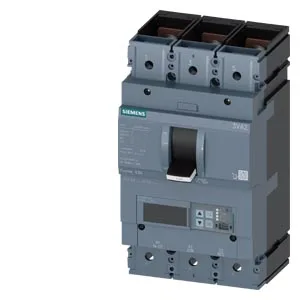
What this MCCB carries — and where it fits
The Siemens SENTRON 3VA2463-6JP32-0CH0 is a 3-pole molded case circuit breaker rated for 630 A continuous current at 40 °C, with an ETU550 electronic trip unit and an undervoltage release. It is a line protection version — meaning it protects cables and busbars from overload and short circuit, not motor protection with phase-loss detection. The 242 kA breaking capacity at 240 V and 187 kA at 415 V give it the headroom to sit upstream in a high-fault installation where downstream breakers need selective coordination. At 690 V it still interrupts 40 kA, so it handles the full range of industrial supply voltages. The 164.5 W maximum power loss matters for enclosure thermal design — a sealed panel with this breaker needs ventilation or derating above 40 °C.
Temperature derating — the real-world current
The 630 A rating holds only at 40 °C ambient inside the enclosure. At 50 °C it drops to 570 A; at 60 °C to 510 A; at 70 °C to 450 A. If this breaker sits in a hot cement plant control room or near a kiln drive, size the load at the derated figure, not the catalogue number. The operating range runs from -25 °C to 70 °C, and storage from -40 °C to 80 °C — it handles the thermal swing of an unheated warehouse or a desert panel.
Auxiliary contacts and communication
The breaker ships with 2 auxiliary switches plus 1 trip alarm switch (HQ version), and it has a communication function — for remote status and trip indication via a bus interface. The integrated auxiliary trip is order code 3VA9608-0BB24; the basic switch without auxiliaries is 3VA2463-6JP32-0AA0. If your panel design calls for a different auxiliary configuration, the base breaker and the aux kit are ordered separately.
Physical fit and panel integration
Dimensions: 138 mm wide, 248 mm high, 110 mm deep. It is a 3-pole frame, so it occupies a single 138 mm-wide slot in a switchboard or panel. The 800 V rated insulation voltage (Ui) means it can be used on 690 V systems without series derating for clearance. The ETU550 electronic trip allows adjustable long-time, short-time, instantaneous and ground-fault settings — coordination with downstream breakers is set via the trip unit, not by swapping thermal elements.
