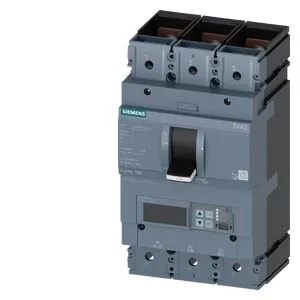
630 A MCCB with 242 kA interrupting capacity — the so-what
The 3VA2463-6JP32-0DC0 is a 3-pole SENTRON molded case circuit breaker rated for 630 A continuous current at 40 °C, with a 242 kA interrupting capacity at 240 V. That 242 kA figure at 240 V drops to 187 kA at 415 V and 440 V, then to 121 kA at 500 V, and 40 kA at 690 V — so the available fault current at your service voltage determines which rating governs the installation.
The 630 A rating is at 40 °C ambient; above that, derate to 600 A at 45 °C, 570 A at 50 °C, 540 A at 55 °C, 510 A at 60 °C, 480 A at 65 °C, and 450 A at 70 °C. The 110 mm depth, 138 mm width, and 248 mm height fit standard MCCB panel cutouts, but the 164.5 W maximum power loss means you need to account for heat dissipation in the enclosure — don't crowd it against other high-loss devices.
The 242 kA at 240 V is the highest short-circuit capacity on record — if your service is 480 V, use the 121 kA figure at 500 V as the conservative SCCR for the panel label. The 15000 mechanical endurance cycles give a service life estimate for switching under no-load conditions; under load, the electrical endurance will be lower and depends on the trip frequency. The ETU550 release allows field-adjustable trip settings, so you can coordinate with downstream breakers without swapping the trip unit.