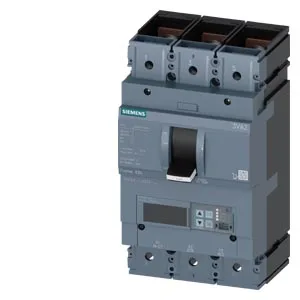
630 A MCCB with ETU560 — what the ratings mean for your panel
The Siemens SENTRON 3VA2463-6JQ32-0JH0 is a 3-pole molded case circuit breaker rated for line protection, carrying a continuous current Iu of 630 A at 40 °C. That 630 A rating is the baseline — the breaker must be derated as ambient temperature rises: 600 A at 45 °C, 570 A at 50 °C, 540 A at 55 °C, 510 A at 60 °C, 480 A at 65 °C, and 450 A at 70 °C. For a panel that runs warm, the 50 °C figure (570 A) is the one to size against, not the 40 °C headline. The ETU560 electronic trip unit handles the protection curve. It includes a voltage trigger and a communication function, so it can report status or accept a remote trip signal — useful when the breaker is part of a monitored distribution system. The auxiliary contact configuration is 2 auxiliary switches plus 1 trip alarm switch (HQ), giving separate dry contacts for status and fault indication back to a PLC or SCADA input. Breaking capacity is substantial: 242 kA at 240 V, 187 kA at 415 V and 440 V, 121 kA at 500 V, and 40 kA at 690 V. At 415 V — common for industrial distribution in many regions — the 187 kA rating means this breaker can be installed at points with very high available fault current without needing a current-limiting upstream device. The rated insulation voltage Ui is 800 V, confirming it is rated for 690 V systems with margin.
Integration — panel fit and wiring notes
Dimensions: 248 mm high, 138 mm wide, 110 mm deep. The 138 mm width for a 3-pole frame is standard for this class — it occupies three 45 mm module positions on a DIN rail or direct-mount plate. The 110 mm depth includes the rotary handle and rear terminals; verify gland-plate clearance if the breaker is mounted near the back of a shallow enclosure. Maximum power loss is 162 W at rated current. Operating temperature range is -25 °C to 70 °C; storage range is -40 °C to 80 °C. Latching endurance is rated at 15,000 operations. Ground-fault monitoring is configured as summation current formation on the L-conductor — it sums the phase currents to detect imbalance. No undervoltage release is fitted; no phase-failure detection is built into the trip unit. If those functions are needed, they must be added externally or specified in a different 3VA2 variant.
