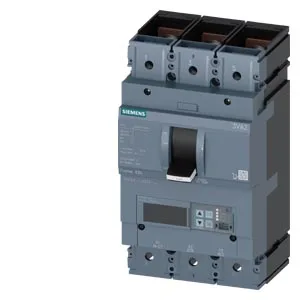
Its continuous current rating is 630 A at 40 °C ambient, with a derating curve you need to follow: 600 A at 45 °C, 570 A at 50 °C, and stepping down to 450 A at 70 °C. Interrupting capacity is 242 kA at 240 V, 187 kA at 415 V and 440 V, 121 kA at 500 V, and 40 kA at 690 V. For a main breaker on a 480 V panel, the 187 kA figure gives substantial SCCR headroom above typical available fault currents — no coordination gymnastics needed to protect downstream gear. The trip unit is an ETU560 electronic release, which provides adjustable long-time, short-time, instantaneous, and ground-fault protection curves. The ground-fault monitoring uses summation current formation on the L-conductor. This is not a basic thermal-magnetic breaker — it requires proper programming at commissioning, and the settings should be locked after coordination study.
Auxiliary and control wiring — what comes integrated
That's enough feedback for a PLC to know the breaker position and whether it tripped on fault versus manual open — no separate aux kit needed. The shunt trip is factory-integrated, so verify the control voltage matches your trip circuit before wiring. Communication function is present on this unit, which means it can report status and trip events over a bus system — useful for a centralized power monitoring setup without pulling additional control wires back to the panel.
Physical fit and mounting
Maximum power loss is 162 W at rated current. That heat has to leave the enclosure — factor it into your thermal budget, especially if this breaker shares a compartment with other high-current devices.