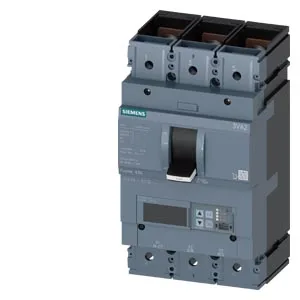
That 630 A is the thermal baseline — at 45 °C it derates to 600 A, at 50 °C to 570 A, stepping down to 450 A at 70 °C, so the actual panel ambient dictates the usable rating. Breaking capacity hits 242 kA at 240 V, 187 kA at 415/440 V, 121 kA at 500 V, and 40 kA at 690 V — these are the SCCR values the breaker can interrupt without fault propagation upstream. The ETU850 electronic trip unit is the brains here: programmable curves, communication function onboard, and the ability to integrate with a higher-level monitoring system via the auxiliary switches (4 HQ contacts supplied).
The 138 mm width across 3 poles is standard for this frame size — verify the backpanel cutout and phase spacing before committing the drill pattern. The 110 mm depth leaves clearance for rear-access wiring and the auxiliary trip module (3VA9608-0BB24) if fitted. Max power loss is 162 W; factor that into the enclosure thermal budget, especially in a sealed panel with no forced ventilation.
Trip unit and communication capability
The ETU850 overcurrent release supports adjustable L-S-I-G (long-time, short-time, instantaneous, ground-fault) protection curves. Communication function is built in — no external module required for basic monitoring integration. No undervoltage release or shunt trip is included as standard (design of the auxiliary release is 'without'), but the auxiliary trip module can be added separately.
No ground-fault monitoring or phase-failure detection is integrated; those functions are handled externally or via the ETU if configured.