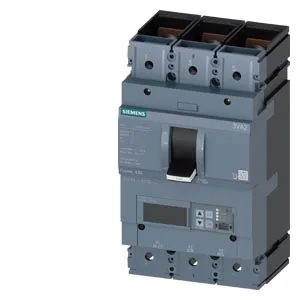
The 110 mm depth and 138 mm width place it in the standard MCCB envelope for 630 A frames; it will swap into existing SENTRON 3VA switchboard mounting without rewiring the bus bars.
The 242 kA at 240 V drops to 187 kA at 415 V and 440 V, then to 121 kA at 500 V, and finally 9 kA at 690 V. That steep derating above 500 V means this breaker is optimized for 240–480 V distribution — not for 690 V motor circuits where a different frame or higher-rated MCCB would be needed. For a 600 V class panel, the 121 kA at 500 V still covers most utility transformer fault levels, but verify coordination with the upstream protective device.
Rated 630 A at 40 °C ambient, the breaker derates linearly: 600 A at 45 °C, 570 A at 50 °C, down to 450 A at 70 °C. Maximum power loss is 164.5 W, which must be factored into enclosure thermal calculations.
Built-in auxiliaries and communication
This variant includes an undervoltage release (UVR) — the design of the auxiliary release is undervoltage release — and a communication function, but no auxiliary switch and no ground-fault monitoring. The communication function allows integration into a power monitoring system, but the specific protocol (PROFIBUS, PROFINET, Modbus?) is not listed in the basic specs; check the order code suffix or the full datasheet for the exact interface. The supplied basic switch is 3VA2463-6KP32-0AA0, which is the mechanical base without auxiliaries.