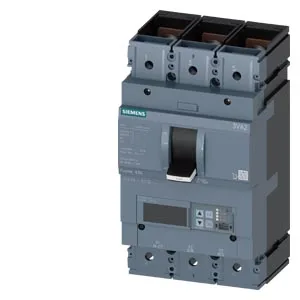
What this MCCB is and what it does
The Siemens SENTRON 3VA2463-6KP32-0KL0 is a 3-pole molded case circuit breaker (MCCB) rated for line protection — meaning it sits at the incoming feeder or main distribution point in a panel, guarding against overload and short-circuit faults before they propagate downstream. Its 630 A rated continuous current (Iu) at 40 °C is the headline number for sizing: that's the load it carries continuously without tripping, and it's the figure you use for busbar and cable sizing. The ETU850 electronic trip unit gives you adjustable long-time, short-time, instantaneous, and ground-fault protection curves, so you can coordinate selectively with downstream breakers. Breaking capacity (SCCR) runs from 242 kA at 240 V down to 40 kA at 690 V — that's the maximum fault current it can safely interrupt at those voltages without welding contacts or rupturing the case.
Temperature derating — don't oversize the panel
The 630 A rating holds at 40 °C ambient inside the enclosure. At 45 °C it derates to 600 A, at 50 °C to 570 A, at 55 °C to 540 A, at 60 °C to 510 A, at 65 °C to 480 A, and at 70 °C to 450 A. If your panel runs hot — near a furnace line, in a sun-exposed cabinet, or packed with other heat sources — you must apply this derating or the breaker will nuisance-trip on a load it should carry. The maximum operating temperature is 70 °C; storage range is -40 °C to 80 °C.
Auxiliary contacts and trip options
This MCCB ships with an integrated auxiliary contact block: 2 auxiliary switches (for status feedback to a PLC or indicator lamp), 1 trip alarm switch (signals that the breaker tripped on a fault), and 1 electrical alarm switch HQ (high-qualified signal for critical alarms). It also includes a shunt trip (STL) release — a voltage-triggered coil that lets you remotely trip the breaker from an E-stop or safety relay. The supplied basic switch is order code 3VA2463-6KP32-0AA0, and the integrated auxiliary trip is 3VA9688-0BL33. No undervoltage release or ground-fault monitoring is built in; those would need separate modules if required.
Communication and measurement functions
The breaker supports communication (fieldbus or serial interface to a higher-level control system) and other measurement functions — meaning it can report current, power, energy, and trip event data over the network. That makes it suitable for energy monitoring and predictive maintenance setups without needing a separate power meter on the feeder.
