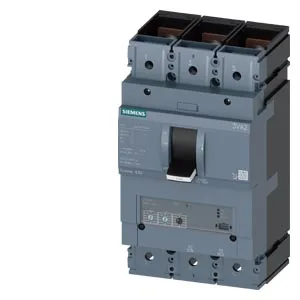
That 630 A figure is the maximum current it can carry continuously without tripping — sized for large feeders, main switchboards, or high-load industrial distribution. Breaking capacity is 330 kA at 240 V AC, 242 kA at 415/440 V, 187 kA at 500 V, and 52.5 kA at 690 V. Current derating is published across the operating temperature range: 630 A at 40 °C, stepping down to 520 A at 70 °C. That derating curve is the number to use for NEC or IEC ampacity calculations, not the 630 A nameplate.
Dimensions: 138 mm wide, 248 mm tall, 110 mm deep. The 138 mm width is a 3-pole frame that occupies three 45 mm module positions on a DIN rail or direct-mount plate — standard for this class of MCCB. Depth of 110 mm includes the arc-chamber and terminal clearance; verify gland-plate depth if the breaker is mounted near an enclosure door. An undervoltage release (UVR) is integrated — part number 3VA9608-0BB25 for the auxiliary trip assembly. The UVR drops the breaker on loss of control voltage, standard for emergency-stop or undervoltage protection schemes. Maximum power loss is 164.5 W — account for that heat in enclosure thermal calculations, especially in sealed or high-ambient cabinets.
Comparison with 3VA1112-5EF32-0CA0
The 3VA1112-5EF32-0CA0 is a smaller-frame SENTRON MCCB (typically 160 A class) with a different trip unit. It will not drop into a panel wired for the 630 A 3VA2463-7HL32-0DH0 without rewiring — the frame size, lug capacity, and bus-bar spacing differ. The 3VA2463-7HL32-0DH0 is the high-current feeder breaker; the 3VA1112 is a downstream branch breaker. No direct second-source relationship exists.